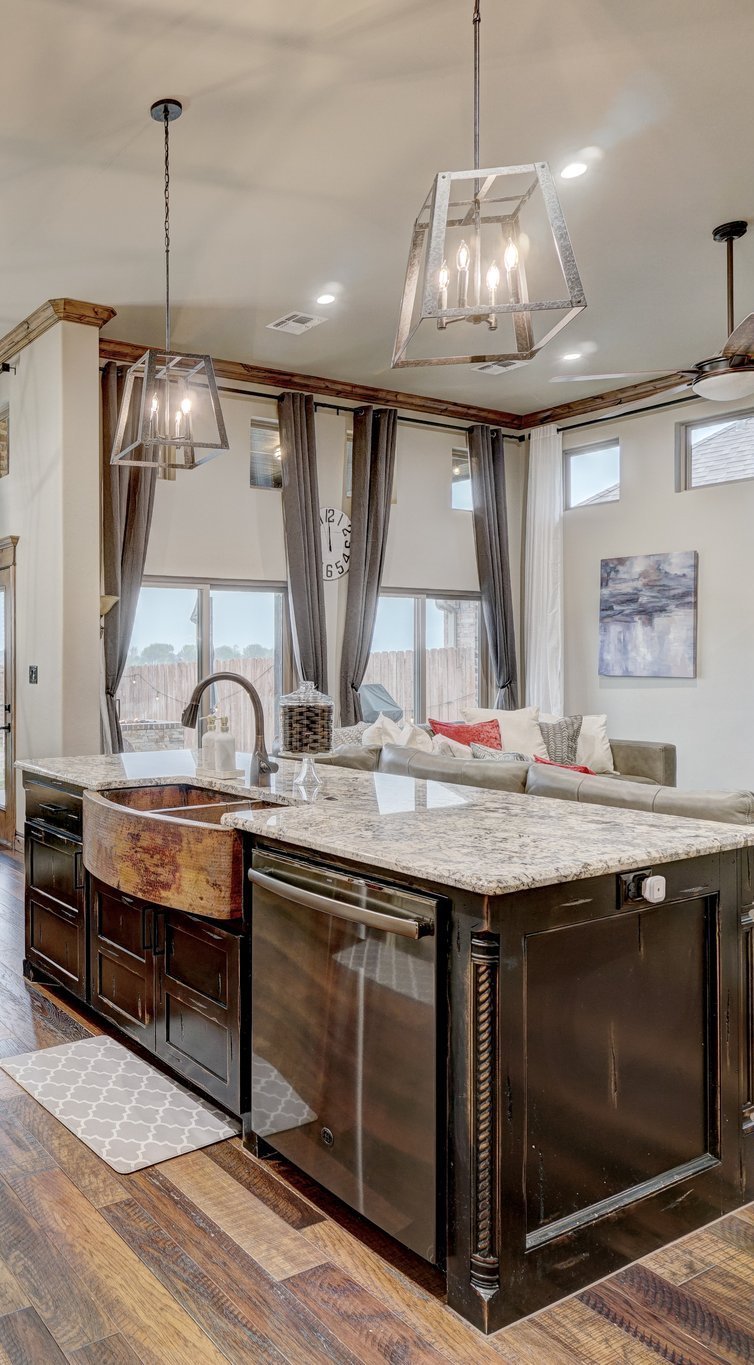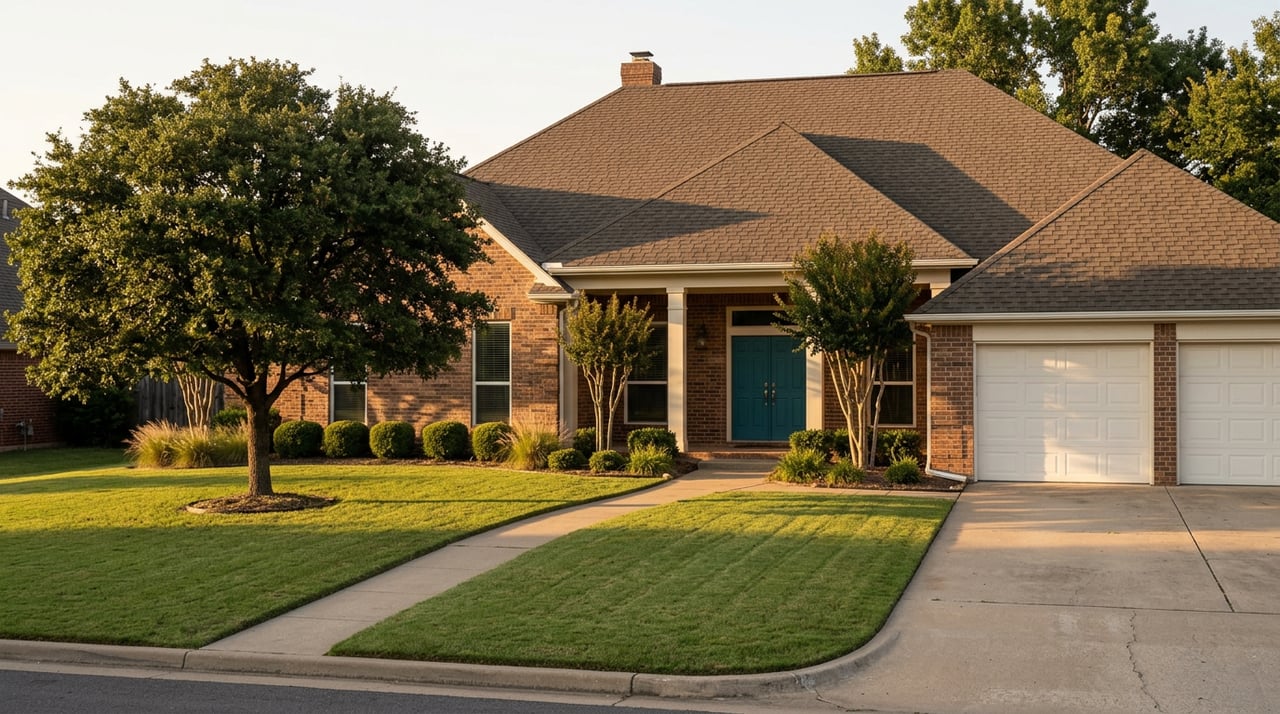
Pull up listings in Lawton on any given afternoon and you can find a home in Sunset Place asking $55,000 in the same city as a home in Wyatt Acres asking $370,700. Both are technically "Lawton." Both would technically factor into the number a portal shows you when you search the market. Neither one looks anything like the other, and neither one looks much like the $141,000 median that gets quoted as the citywide answer.
That's the thing about a median. It's not describing a place. It's describing an average of a lot of places that don't have much to do with each other, and in a city as spread out as Lawton, that average can end up sitting between two markets rather than inside either one.
What the citywide number is actually built from
The most recent published figures, covering March 2026, put Lawton's median sale price at $141,000, down 4.9 percent from the same month a year earlier. Homes were taking longer to sell too, an average of 89 days on market compared to 67 days the prior year, and fewer of them were closing: 91 sales that month versus 96 a year before. Inventory data from the same window shows 417 homes on the market with months of supply climbing to 4.7, up from 1.75 a year earlier. That's a meaningfully looser market than the one Lawton had a year before, and it's the backdrop against which every neighborhood-level number below should be read.
None of that tells you where to actually look, though. Lawton's housing stock spans mid-century ranch homes near downtown, golf-adjacent brick construction on the west side, and everything in between, and a citywide median has to average across all of it.
The same city, priced like several different ones
Pull the neighborhoods apart and the range gets a lot more specific. A recent snapshot of listings across Lawton's named neighborhoods showed asking prices running from $55,000 in Sunset Place to $370,700 in Wyatt Acres, with a long, uneven middle in between.
| Neighborhood | Listed price in the snapshot |
|---|---|
| Sunset Place | $55,000 |
| Rolling Meadows | $94,900 |
| Country Club West | $119,000 |
| Westwood | $121,750 |
| Liberty Heights | $137,450 |
| Lawton View | $139,900 |
| Ridgecrest | $146,950 |
| Eisenhower Village | $205,000 |
| Woodland Hills | $209,000 |
| Wyatt Acres | $370,700 |
That's a single-listing price at a single moment, not a neighborhood's full price band, so treat each figure as a data point rather than a verdict. But the spread itself is the story. A buyer comparing "Lawton" to another city on a portal is really comparing an average of a $55,000 market and a $370,700 market, and that average describes very little about what either one is actually like to live in or shop for a home in.
Woodland Hills, for instance, sits on the western side of the city where mature timber and rolling ground are unusual enough for the region that they function as a real amenity. Along Cache Road nearby, residents shop at Homeland, an Oklahoma-based grocery chain, and can grab a meal at Nami Korean-Japanese, all in the same retail strip that also includes a Lawton Marketplace anchored by national names like Target and Old Navy. It's a neighborhood built around detached, tree-shaded lots, and its price band reflects that scarcity.
Drive across town to the Country Club Estates area near Gore Boulevard and the texture changes entirely. Homes there run mostly single-story and closer together on compact lots, about five miles from Fort Sill and a mile from Comanche County Memorial Hospital. Residents gather at the weekly Lawton Farmers Market and the Freedom Festival at Elmer Thomas Park, a 120-plus acre park that also holds a splash pad, a disc golf course, a skate park, and a planned aquatic center. Grab coffee at Lucky Buck's Coffee Shack, tacos at Taco Mayo, groceries at the nearby Walmart Neighborhood Market. It's a different rhythm of daily life than Woodland Hills, and it shows up in the price gap between the two.
That's the useful version of a median: not a single number to anchor a search around, but a reminder that "Lawton" is shorthand for several distinct housing markets stacked under one city name.
When a percentage change is really just noise
Here's where the neighborhood-level data gets genuinely tricky, and where a buyer relying on an appreciation ranking or a "hot neighborhood" tool can get led astray.
Lawton View's numbers for the three months ending in May 2026 showed a median sale price of $165,000, described as a 967.6 percent increase over the same period a year earlier. Read quickly, that looks like an incredible run. Read carefully, it's a small-sample artifact. Only six homes sold in that window, down from eight the year before, and days on market more than tripled, from 33 days to 112. A swing that large off six transactions isn't a trend. It's what happens when a handful of home sales at different price points get compared to a handful of home sales at very different price points a year earlier. The percentage is real. The story it seems to tell isn't.
This is the trap with neighborhood-level real estate data in a market Lawton's size. The city has enough transaction volume for citywide numbers to mean something, but plenty of its individual neighborhoods close so few sales in a given quarter that one unusual transaction can swing the percentage by triple digits without reflecting anything about where that neighborhood's values are actually headed. Before treating any neighborhood's year-over-year percentage as a signal, it's worth asking how many sales it's built on. A handful of closings is a data point, not a trend line.
Sources don't even agree with each other
There's a second layer of confusion worth naming honestly. A separate roundup of Lawton neighborhoods published in mid-2026 put Country Club West's typical price band at $230,000 to $345,000, executive-style brick homes with high-end finishes. That's a very different picture from the $119,000 asking price showing up in the same-day snapshot above.
Both can be true at once. A single current listing at $119,000 might be a smaller or older home inside the same named neighborhood boundary as newer construction pushing well past $300,000. Neighborhood names in Lawton, like most cities, don't always map cleanly to a uniform housing stock, and a boundary drawn for MLS or marketing purposes can contain more variety than the label suggests. The lesson isn't that one source is wrong. It's that a single asking price, or even a published price band, is a starting point for a conversation, not the final word on what a specific street or block is worth.
What this means if you're actually shopping in Lawton right now
If you're comparing Lawton neighborhoods off portal data alone, three things are worth doing before you draw any conclusions:
- Ask how many homes actually sold behind any median or percentage you're looking at. A number built on five or six transactions deserves more skepticism than one built on fifty.
- Treat neighborhood price bands as ranges to investigate, not numbers to trust at face value, especially when two sources disagree.
- Pay attention to the citywide context of longer days on market and higher months of supply. In a looser market, individual neighborhood numbers get noisier, not less, because fewer transactions are setting each data point.
None of this means the citywide median is useless. It's a fine way to get oriented on Lawton relative to other cities. It's just the wrong tool for deciding between one street and another, and that's the decision that actually matters once you're ready to make an offer.
A few questions that come up often
Why do different sites show such different price ranges for the same neighborhood? Neighborhood boundaries used by portals and marketing sites don't always match, and a single current listing can sit far from a neighborhood's typical range. Both numbers can be accurate and still describe different slices of the same area.
Is a neighborhood with a huge year-over-year price jump actually appreciating that fast? Not necessarily. In a neighborhood with a small number of annual sales, one unusually priced closing can swing the percentage dramatically without reflecting a real shift in value.
Does a rising median days-on-market number mean prices are about to drop further? It means buyers have more room to negotiate and more time to compare options than they did a year ago. It doesn't predict where any single neighborhood's prices go next, which is exactly why neighborhood-level homework matters more in a slower market, not less.
The bottom line
Lawton's median home price is a real number, and it's useful for understanding the city in broad strokes. But it's an average built from neighborhoods that don't behave like each other, some with enough sales volume to trust the trend and some without, and the only way to know which neighborhood you're actually looking at is to get past the headline figure and into the specific streets.
If you're trying to figure out which Lawton neighborhood actually matches your budget and the way you want to live, The Wright Team can walk you through the current inventory street by street, not just the citywide average. Search Homes to see what's actually available right now.